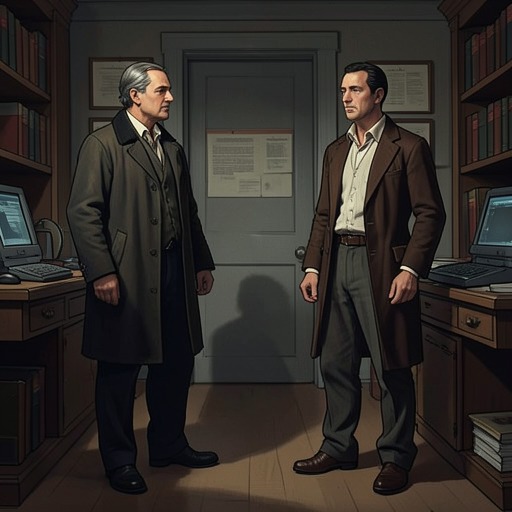
Rob Ryan and Cassie Maddox
In the WoodsRob Ryan and Cassie Maddox’s relationship turns on a sudden shift from practiced partnership to physical intimacy, followed by Rob’s insistence that their closeness has been irreversibly changed. The encounter does not settle into a romance: it leaves two partners facing different interpretations of what happened and the loss of an easy familiarity neither had expected to put at risk.
Partnership and Familiarity
Their professional bond is close enough to carry its own choreography. During interrogations, Rob and Cassie have repeatedly used a feigned lunge as a last resort to pressure a suspect they believe guilty but cannot get to confess. Cassie grabs Rob’s raised arm and restrains him, then watches him as she resumes questioning, ready for any renewed outburst. Rob remembers having performed this routine with her perhaps ten or twelve times. Their practiced coordination makes the real confrontation that follows feel different to him: this time, he says, is not another performance, and Cassie’s intervention frustrates him because she does not seem to recognize the distinction.
That intimacy also consists of small, habitual acts beyond the interview room. After they sleep together, Cassie removes her sweater and settles beside Rob; he puts his arms around her without thinking, and she curls against him. The ease of the gesture is continuous with the familiarity he later grieves: before the encounter, she had reached into his coat pocket for his lighter in the castle gardens without interrupting her conversation. Rob had loved the unthinking confidence of that moment. In retrospect, he sees ordinary shared habits as newly charged, not because they were planned as courtship but because he can no longer experience them as neutral.
The Night and Its Aftermath
Rob describes their night together as something neither anticipated. He recalls the simple preparations before bed: Cassie taking out her hair clips, and him tucking his socks into his shoes so she would not trip over them in the morning. He rejects the idea that either had knowingly been moving toward intimacy. The morning after, he avoids going near the Knocknaree site while it is deserted, walks home instead, and feels the encounter’s consequences as an expanding personal and professional crisis.
For Rob, the available conventional responses—beginning an official relationship or ending communication—both seem impossible. He cannot cut off contact with Cassie because she is his partner, while a romantic relationship feels beyond what he can manage amid his existing difficulties. He also understands that their relationship is subject to police regulations. More immediately, he fears the loss of the friendship’s former freedoms: drinking with Cassie late into the night, talking about women he has met, and sleeping on her sofa. In his account, the encounter makes those familiar forms of companionship unavailable even before either partner has decided what should replace them.
Conflicting Interpretations
When Rob and Cassie discuss what happened, he says that going back to normal may no longer be possible. He calls Saturday night a major mistake, regrets that it happened, and says they are stuck with its consequences. Cassie’s face briefly shows hurt at his judgment, and she answers that it need not be a mistake. Rob holds to his position, attributing the encounter to his own disordered state and saying it should not have happened.
The exchange leaves their relationship unresolved rather than repaired. Rob treats the intimacy as a rupture in the partnership’s former terms; Cassie does not accept that regret is the only possible meaning of it. Their disagreement is sharpened by their shared closeness: neither can simply disappear from the other’s life, yet Rob cannot imagine returning to the habits that once made their bond feel uncomplicated. The relationship’s decisive change is therefore not a settled romantic commitment but the loss of certainty about what their partnership can still be.